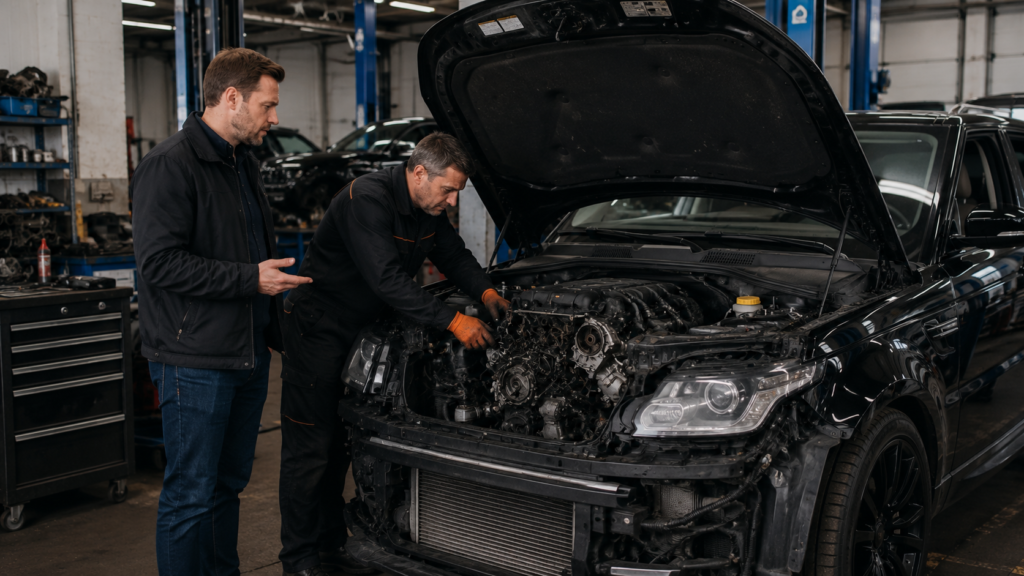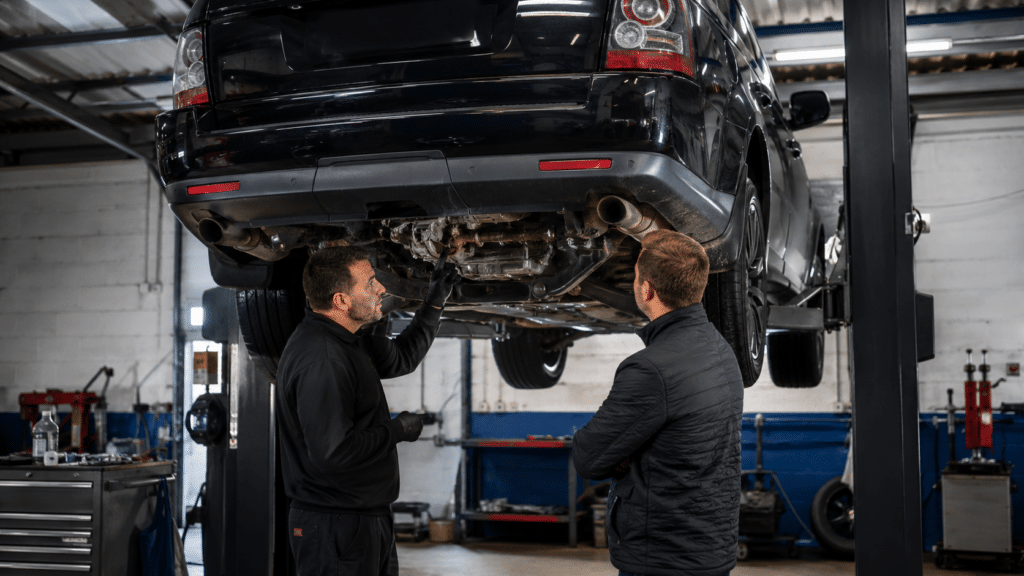
A judder on a tight turn can make a transfer box repair sound inevitable. It is not enough evidence on its own. Before agreeing to a replacement, ask the garage what tests identify the transfer box, which assembly your Range Rover has and what the quoted repair actually includes.
If the vehicle has become unreliable or the estimate is more than you want to spend, you can also compare it with an offer for the car in its current condition. This guide explains how to make that comparison without treating every transmission noise as the same fault.
What does the transfer box do?
The transfer box, also called a transfer case, is part of the drivetrain that distributes drive towards the front and rear axles. It is a separate component from the main gearbox. The differentials and other driveline components have their own roles, even though a driver may experience faults in any of them as vibration, noise or poor drive.
The important detail is the vehicle’s exact specification. Land Rover and Range Rover models do not all use one interchangeable drivetrain arrangement. Give the workshop the registration and VIN, and ask which unit it has identified before comparing parts or repair prices. A quote for another generation of Range Rover may not describe the job on yours.
Judder, vibration and noise need a diagnosis
Write down when the problem happens: pulling away, turning slowly, accelerating, cruising or changing between drive and reverse. Say whether it occurs hot, cold or both, and record the wording of any dashboard message. This gives the technician a repeatable description rather than just “gearbox trouble”.
A useful assessment should distinguish the transfer box from the main transmission, differentials and other possible sources of vibration. Ask for the findings behind the proposed repair, not simply a list of stored codes. If the car is unsafe, has lost drive or is making severe mechanical noises, arrange professional assessment and recovery rather than repeatedly testing it on the road.
What the manufacturer’s bulletin does—and does not—tell you
A Jaguar Land Rover technical bulletin dated 17 May 2018 discusses low-speed turning judder on specified Range Rover and Range Rover Sport vehicles with a twin-speed transfer case. It sets out a professional diagnostic and repair process, rather than treating replacement of the complete unit as the only possible response.
That is a historical North American bulletin with model-year, VIN and equipment limits. It is not a UK recall, a current universal repair instruction or proof that your car has the same problem. Ask a Land Rover specialist to check the current information applicable to your VIN. Its useful lesson for an owner is that the repair should follow a specific diagnosis.
Questions to ask about a transfer box repair quote
- Which tests support the diagnosis, and has the main gearbox or differential been ruled out?
- Is the proposal for service work, a component repair, a rebuilt exchange unit or a new assembly?
- Does the price include removal and refitting, fluids, calibration where required, VAT and road testing?
- If an exchange unit is supplied, are there return conditions or a surcharge for the old unit?
- What parts and labour warranty applies, and who deals with a problem after fitting?
- Could further dismantling change the estimate, and will the garage obtain approval first?
Request the scope in writing. A unit advertised online can exclude fitting and other essential work, while a garage’s total may include those items. Comparing only the headline numbers can make the more complete quote look unnecessarily expensive. There is no single transfer box replacement price that reliably covers every Range Rover.
When repairing may be the better option
A confirmed, contained fault in a vehicle you know and want to keep can justify a repair. Consider its service history, body condition, recent maintenance and the quality of the proposed work. Ask whether the repair addresses the identified cause and whether any separate work is already due.
You do not need to write off an otherwise suitable car because one estimate sounds large. Equally, money spent previously cannot guarantee that the next repair will make ownership economical. Focus on the cost and uncertainty still ahead of you.
When selling with the fault may make sense
Selling may suit you if you no longer need the car, do not want to authorise more investigation or are facing several unrelated repairs. Compare a written offer for the vehicle as it stands with the repair bill, recovery or storage costs and the likely value to you after repair. These are individual figures; an online retail advert is not a guaranteed sale price.
We Buy Broken Land Rovers considers vehicles with drivetrain faults and non-runners. Request a valuation through our Kent Land Rover buying service. Tell us the diagnosis, mileage, condition and where the vehicle is kept. If you are in west Kent, our Sevenoaks and Tonbridge pages explain local collection arrangements. A valuation is free and no obligation.
What to send with your enquiry
Include the registration, mileage, postcode, garage report and repair estimate if available. Explain whether it starts, rolls and steers, and whether any parts have been removed. If it is at a workshop, agree release and tell us about access restrictions before collection is booked.
If the diagnosis points to the main transmission instead, read our guide to gearbox problems. If it has lost drive altogether, our non-runner selling guide covers the information needed to arrange recovery. Neither a valuation form nor a dashboard message replaces an inspection.
Sources checked: 29 October 2026. Technical context: Jaguar Land Rover bulletin LTB00906NAS5, linked above. This article provides owner decision guidance; vehicle-specific diagnosis and repair procedures belong with a qualified workshop.