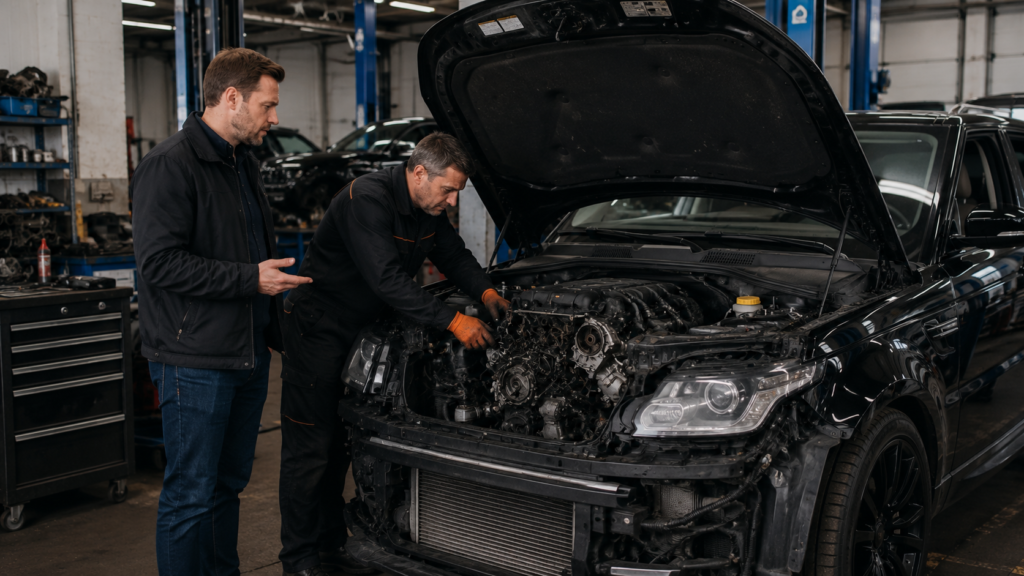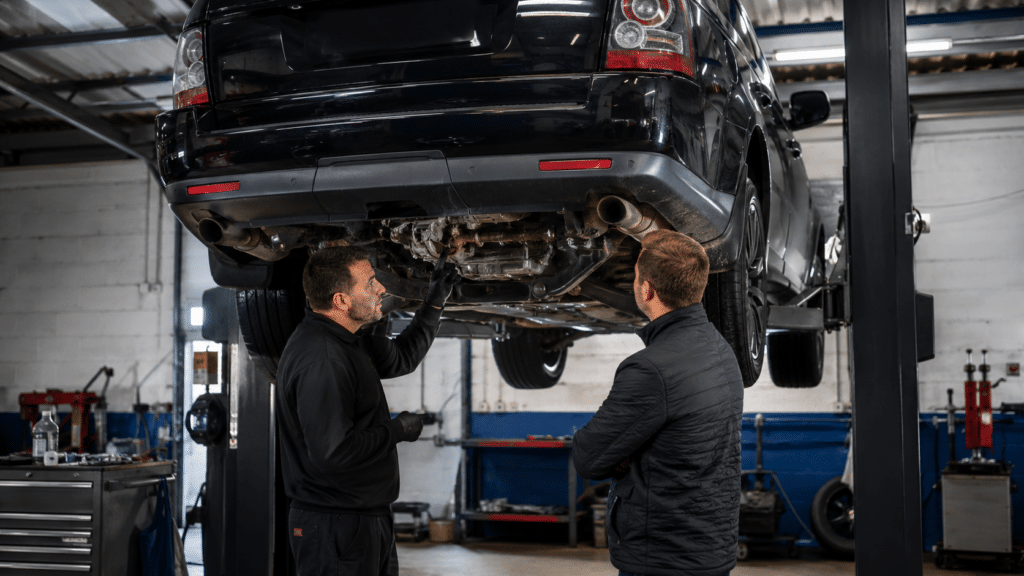
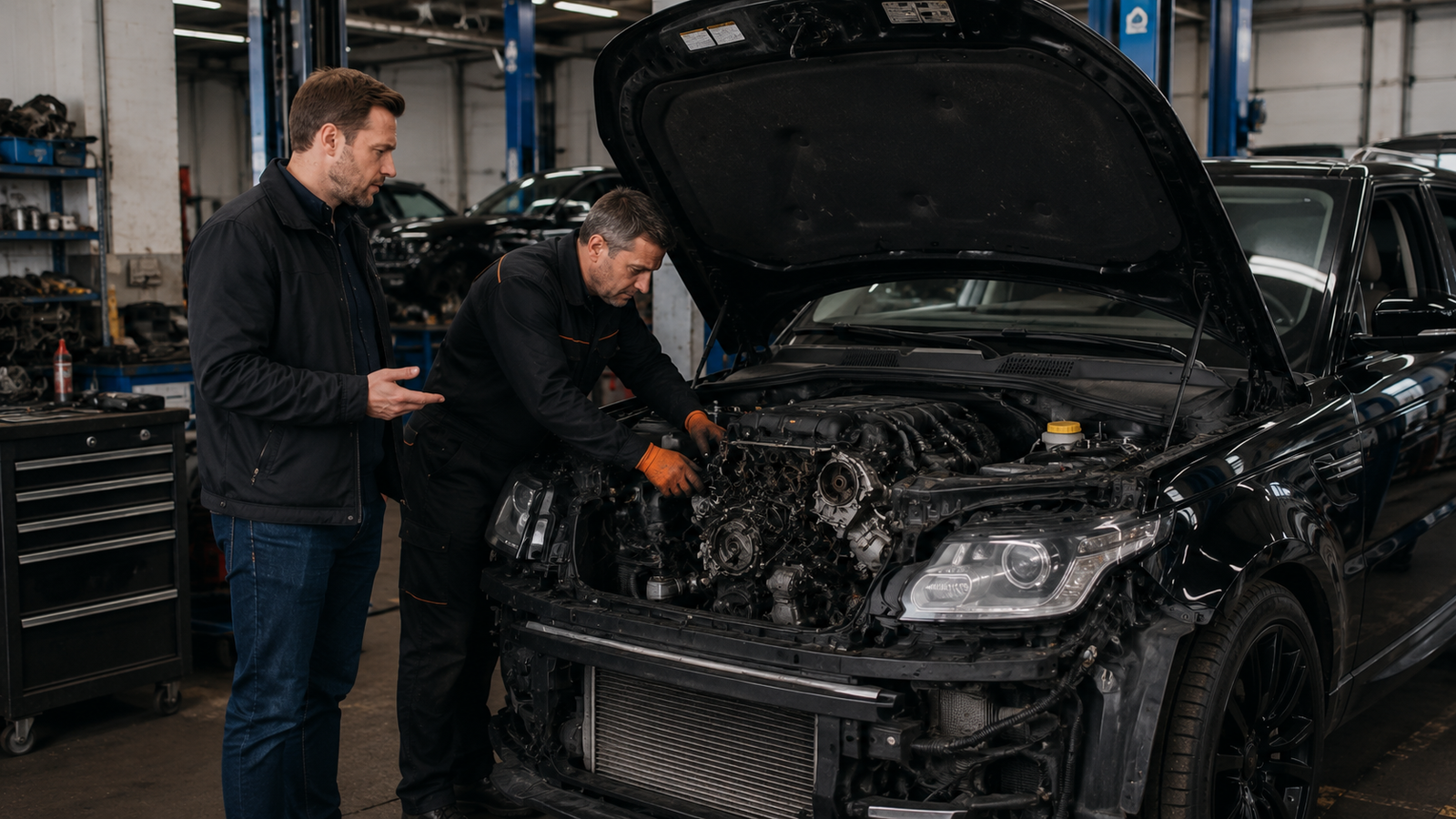
A turbo advertised for a few hundred pounds and a workshop estimate running into thousands may describe very different purchases. The first can be a component only; the second may include access, fitting and work needed to address the cause of failure. Before deciding whether to repair or sell your Land Rover, compare the complete job.
There is also a more basic question: has the turbo itself been shown to be faulty? Loss of power, smoke or a restricted performance message should start an investigation, rather than automatically authorise an expensive replacement.
How much does Land Rover turbo replacement cost?
For a dated UK example, independent Land Rover specialist K Motors publishes guide prices including VAT of £1,695–£1,995 for 2.0 and 2.2 single-turbo replacement, and £2,600–£4,500 for V6 and V8 twin-turbo replacement. It says the exact cost is confirmed against the VIN after diagnosis. These figures were checked on 29 October 2026.
Those are one workshop’s published examples, not a national average, a quote from us or a price for every Discovery, Defender or Range Rover. Engine specification, the number of units being replaced, access and the condition of related components can change the job substantially. Obtain a written estimate for your exact vehicle.
Confirm the cause before buying a turbo
Turbocharger manufacturer Garrett’s diagnostic guide advises identifying the cause of a problem before replacement. The turbo can be affected by a problem elsewhere in the engine or its supporting systems. Replacing it without resolving that cause can leave the new unit exposed to the same conditions.
BorgWarner’s troubleshooting guidance also shows why symptoms alone are not a diagnosis: poor performance, noise, smoke and oil-related complaints can have several causes. Ask what the workshop has established about the unit itself and any contributing problem, rather than interpreting an underboost code as a complete repair instruction.
This is especially important when a report says only “suspected turbo”. Ask what further testing costs and whether authorisation is needed before dismantling. If the car is producing heavy smoke, consuming oil rapidly or behaving abnormally, stop using it and arrange professional advice and recovery. Do not keep driving it to prove the fault.
What a fitted replacement quote should explain
- The engine and exact turbo arrangement identified from the vehicle details.
- Whether the quote replaces one unit or more than one, and why.
- Whether the parts are new, remanufactured or exchange units, with any return surcharge explained.
- Removal and fitting labour, plus any access work needed on that model.
- Oil, filters, pipes, seals, cleaning or other associated work identified by the diagnosis.
- Testing or calibration where required, VAT, and the parts and labour warranty.
Not every item applies to every engine. Ask the garage to explain what is necessary on yours and what is optional. A statement that every Land Rover needs the same dismantling, or that both turbos must always be changed, is not a substitute for a vehicle-specific explanation.
Why a parts-only price can mislead
A catalogue listing may require your old turbo to be returned in an acceptable condition. It may also exclude fitting, consumables and work on the cause of the failure. Check the full amount payable, the exchange terms and the correct part reference before comparing it with a fitted repair estimate.
Buying the component yourself can also split responsibility between the supplier and installer. Establish whether the garage will fit a customer-supplied unit and who covers labour if a problem arises. A low purchase price is less useful if the workshop will not support the arrangement.
Deciding whether the repair is worth it
Consider the vehicle’s condition beyond the immediate turbo issue. A well-maintained Land Rover you intend to keep may justify a confirmed repair. If it also needs major engine work, has other unresolved faults or no longer suits your needs, the total commitment can be harder to justify.
Compare three figures: the complete repair estimate, an offer for the car in its present condition, and a realistic assessment of its value to you after repair. Add recovery or storage costs where relevant. Do not assume the highest advertised retail price is what you could obtain privately, or that a repaired car will have no further maintenance needs.
Selling a Land Rover with a turbo fault
We Buy Broken Land Rovers considers vehicles with confirmed or suspected turbo problems, including non-runners. You can request a free, no-obligation valuation without having the turbo replaced first. Disclose the report honestly: say “suspected” if the garage has not confirmed the cause.
Start with our Kent Land Rover buying service and include the registration, mileage, condition and collection postcode. Our Gravesend, Whitstable and Folkestone pages explain local collection details. Tell us if the vehicle is dismantled, cannot roll or needs release from a garage.
Related warnings and next steps
If your main concern is the dashboard message, our restricted performance guide covers the broader issue. If a workshop has identified wider damage, read our engine failure selling guide. Keep the written diagnosis and estimate: they make both a second repair opinion and a fault-aware valuation more useful.
Sources and prices checked: 29 October 2026. The linked K Motors figures are external guide prices and may change. Garrett and BorgWarner provide the technical diagnostic context. We buy vehicles; the repair examples are not a workshop service or repair guarantee offered by us.